

A VFD for crane and hoist work has to do three jobs at once: hold full torque at zero speed, absorb the energy that lowering a load creates, and keep the mechanical brake closed until the motor can carry the load by itself. A general purpose variable frequency drive does none of this out of the box. The gap between the two is where lifting accidents and expensive retrofits start. If you specify, buy, or maintain lifting equipment, this guide covers torque control, braking options, the safety functions worth paying for, and a checklist you can reuse on the next project.
Why Hoist Duty Is Hard on Drives
A hoist motor fights gravity in both directions. Lifting needs full torque at every speed. Lowering turns the same motor into a generator, and the energy has to go somewhere.
Overload is the second problem. A hoist drive typically supplies 150% of rated current for 60 seconds and about 200% starting torque at 0 Hz to break a loaded hook away from standstill. Fan and pump drives never see numbers close to these.
Constant torque plus constant regeneration is why crane duty is a separate product class, not a settings file on a standard unit.
Torque Control: Holding the Load Before the Brake Opens
The mechanical brake on a hoist is a parking device. It should never catch a moving load, so the motor has to take over the weight before the brake opens.
Here is the sequence in practice. The drive magnetizes the motor, ramps torque up to the load holding value, confirms the value through its current model, and only then signals the brake to open. Operators feel the difference as a clean start with no dip or slide in the first centimeter of travel. A vector control drive like the GK310 ac drive runs the check on every single start.
Picking a Control Mode for Each Motion
| Control mode | Torque at 0 Hz | Where it belongs on the crane |
|---|---|---|
| V/f | Poor | Bridge and trolley travel |
| Sensorless vector | Good without encoder | Light hoists, budget builds |
| Closed loop vector with encoder | Full holding torque | Hoist motion on any duty class |
For the hoist itself, closed loop vector with an encoder is the safe default. Travel motions are far less demanding, so simpler modes save money there without adding risk.
Where the Braking Energy Goes
Every meter of descent pushes energy into the DC bus of the drive. The drive either deals with the energy or trips on overvoltage. Two methods cover nearly every installation.
| Method | How it works | Best fit |
|---|---|---|
| Braking resistor | A chopper switches a resistor across the DC bus and burns the energy as heat | Light duty, low cost retrofits |
| Regenerative unit | An active front end feeds the energy back into the grid | High duty cycles, port cranes, frequent lowering |
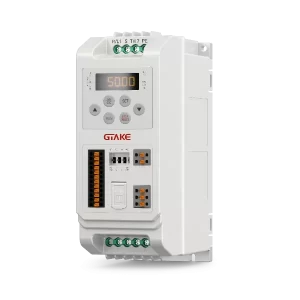
A compact unit like the GK920 Variable Frequency Drive includes the braking transistor, so you only add the resistor. Sites that lower heavy loads all day usually justify a regenerative unit, because the recovered energy shows up on the power bill instead of as switchroom heat.
Brake Sequencing and Torque Proving
The brake sequence is where hoist drives earn their price. The full cycle, start to stop, runs like this:
-
The drive builds torque while the motor is still held.
-
Torque proving confirms the motor carries the load.
-
The brake opens and the drive accelerates on its ramp.
-
At the stop command, the drive decelerates to creep speed, sets the brake, and waits for the brake feedback contact before cutting torque.
Elevator VFD systems run the same logic, which is why both machine types face similar functional safety expectations. GTAKE applies the sequence across its hoist solutions, from tower hoists to paper mill cranes.
Safety Functions Worth Specifying
Brake control is only the start. Before signing off on a drive, check that it supports:
-
Safe Torque Off (STO) certified to SIL 2, which removes motor torque without a full power down
-
Overspeed protection against runaway lowering
-
Slack rope and overwinding detection
-
Torque limited overload protection, so the drive refuses lifts beyond rated load
-
Travel limits with deceleration zones at both ends of the stroke
An experienced AC drive manufacturer documents each function and helps you map the drive to CMAA or FEM requirements. Ask for the safety manual, not the brochure.
A Selection Checklist That Holds Up in the Field
Work through these steps before ordering:
-
Split the motions. Hoist, trolley, and bridge each get their own sizing.
-
Size by current, not by kilowatts. Use motor full load current plus the overload window.
-
Confirm the overload class. Hoists need heavy duty ratings, usually 150% for 60 seconds.
-
Assign a control mode to each motion. Closed loop vector on the hoist, simpler modes on travel.
-
Calculate braking energy from the lowering duty, then choose resistor or regenerative.
-
Define brake logic: torque proving, brake feedback, and fault responses.
-
Derate for heat, altitude, dust, and cabinet cooling.
Large port and mine hoists are a separate conversation, since a medium voltage drive like the GK690 moves megawatt class loads with far lower current and smaller cables.
What This Looks Like on Real Sites
On construction sites, GK620 inverters run passenger and material hoists with ramps gentle enough to protect the mast and gearbox. In a pulp and paper mill, a crane modernization swapped aging control gear for vector drives and cut brake wear while cycle times improved.
The savings in both projects came from fewer brake replacements, less downtime, and lower energy waste, not from the purchase price.
Why the Manufacturer Matters
Firmware is the difference between a hoist drive and a standard drive with a hoist label. A specialized variable frequency drive manufacturer builds brake logic, torque proving, and safety functions into the product, then tests the full sequence under load. GTAKE works this way with crane OEMs and end users, from compact book type units to medium voltage systems. When something goes wrong mid project, you want an engineer on the phone, not a ticketing system.
Frequently Asked Questions
Do all hoists need closed loop control?
Light duty hoists run well on sensorless vector. Hoists carrying people, molten metal, or loads above roughly 10 tons should use closed loop vector with an encoder.
Braking resistor or regenerative unit?
Low duty cycles favor a resistor for its low cost. Operations lowering heavy loads many times per hour recover the extra cost with a regenerative unit.
How much overload capacity does a hoist VFD need?
Plan for at least 150% of rated current for 60 seconds, and 200% starting torque at zero frequency for heavy breakaway loads.
Key Takeaways
A hoist VFD earns its keep on three points: full torque at zero speed, braking matched to the duty cycle, and safety functions built in rather than bolted on. Get those right and the mechanical brake becomes a parking brake that lasts for years. Run your next project through the checklist above, and if you want a second opinion on your motion data, contact us .