

Choosing an electric motor for an agricultural machine is only the first part of an electrification project. The controller has to deliver the required torque, handle the battery voltage, manage heat, communicate with the vehicle, and operate within the vehicle’s high-voltage protection strategy when field conditions are far from ideal.
The relevant question is whether a high-current controller can support the real working day, rather than only a short peak recorded on a datasheet. That requires current and thermal sizing against the machine’s actual work cycle.
Why agricultural work creates a high-current problem
Ground-engaging work, towing, incline starts, and load changes can all require substantial torque at low vehicle speed. In these conditions, the controller must respond to demand without losing thermal margin. It also has to work alongside pumps, fans, compressors, implements, and other loads that may share the vehicle’s electrical system.
A tractor pulling an implement, a self-propelled work machine moving on uneven ground, or an automated platform operating several electric loads at once does not follow the duty cycle of a passenger car. Controllers must be selected around the work, not around a single headline power figure.
A controller can look suitable when it is compared only with the motor’s rated power. That comparison misses two questions that usually decide whether the system works in the field:
- How much current is needed during the highest-load event, and for how long?
- How much power must the system sustain during normal work without excessive temperature rise or derating?
Peak current supports short, demanding events. Continuous capability determines whether the machine can keep working. Both need to be checked against the actual operating profile.
Map the duty cycle before reading the nameplate
Before selecting an electric motor controller, map the machine’s workload. Include traction demand, auxiliary demand, daily operating hours, planned charging periods, ambient temperature, and the most demanding work event.
| Operating condition | Electrical demand | Controller question |
| Heavy traction or tillage | High torque over an extended period | Can the controller sustain the required current under available cooling? |
| Starting, climbing, or pulling a load | Short-duration torque peak | What peak current is available, and what is its permitted duration? |
| Precision or automated work | Frequent speed and torque adjustments | How quickly and accurately can the controller regulate the motor? |
| Dust, water, vibration, and heat | No direct torque demand; raises installation and derating risk | How are enclosure, cooling, connectors, and routing handled as a system? |
This approach prevents a common mistake: choosing a controller that can meet a short peak requirement but lacks the thermal capacity needed for a long working day.
A practical peak-vs-continuous sizing method
Step 1 — List the highest-load events
Examples: loaded start, slope climb, implement engagement, soft-ground recovery. For each event, estimate required torque/current and duration in seconds or minutes.
Step 2 — Separate continuous field work
Estimate the current or power that must be held through normal tillage, towing, or transport segments, including auxiliaries that stay on.
Step 3 — Add simultaneous loads
Pumps, fans, compressors, and implements can share the electrical system. Combined demand affects battery power capability, controller thermal load, and cable sizing.
Step 4 — Compare with published peak duration
If a controller lists peak current for one minute, ask whether the real event is shorter, equal, or longer—and whether events repeat before the system can cool.
Step 5 — Check cooling-loop boundary conditions
Liquid cooling can help remove heat from a high-power controller, but coolant flow, coolant temperature, radiator capacity, hose routing, and maintenance access all affect how much of the published capability can be used. Heat is also generated in the motor, cables, connectors, and battery.
Step 6 — Confirm voltage architecture with current
If the calculated continuous or peak current forces oversized cables, connectors, or thermal risk, revisit whether a higher-voltage platform would reduce current before locking the controller rating. Raising system voltage can reduce current at a given power, but it also increases emphasis on insulation, connectors, contactors, interlocks, and service safety. High current remains useful only when matched to the motor, battery, cables, cooling loop, and expected work cycle.
Common sizing mistakes
- Selecting from motor rated power alone.
- Treating peak amperes as continuous capability.
- Ignoring auxiliary loads that run during traction.
- Assuming datasheet current is available at any coolant temperature.
- Ignoring repeated peaks that stack heat across a working day.
- Treating IP67 as a complete installation solution while connectors or cable routing remain weak points.
Technical reference: GTAKE G04
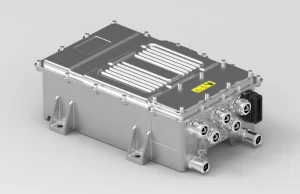
GTAKE’s G04 EV/HEV Motor Controller is a high-voltage motor controller with a published specification set that can be used when assessing a high-current architecture for an electrified work machine. The G04 supports synchronous and asynchronous motors and has a 400–750 VDC input range, with a rated input voltage of 540 VDC.
The product page lists peak-current options of 570 A, 690 A, and 900 A for one minute. It also lists an output frequency range of 0–1000 Hz, resolver position sensing, two motor-temperature sensing channels, and optional terminal resistance with a customizable CAN protocol.
For response and operating conditions, the published information lists torque response below 5 ms, torque-control accuracy of ±5%, water cooling, IP67 protection, an ambient-temperature range of −40°C to 85°C, and relative humidity from 5% to 95% without condensation. The page also lists rated-working-point efficiency of at least 98%.
GTAKE’s public G04 page does not identify agricultural machinery as an application. Treat these characteristics as project-evaluation inputs, not evidence of agricultural deployment. Final fit still depends on the complete machine design, including duty cycle, motor selection, cooling capacity, installation, safety architecture, and validation plan.
One-page current and thermal worksheet
| Input to prepare | What to record | Pass question |
| Machine type and implement | Tractor / work machine / automation platform | Is the work cycle documented? |
| Battery voltage | Nominal and maximum VDC | Does controller input range cover it? |
| Continuous traction demand | Current or power + hours | Can cooling sustain it without derating? |
| Peak event #1/#2/#3 | Current + duration + repeat interval | Is published peak duration enough? |
| Auxiliary loads | Pump/fan/compressor power while moving | Is combined demand included? |
| Coolant conditions | Flow, inlet temperature, radiator margin | Are datasheet ratings valid in this loop? |
| Installation risks | Dust, water, vibration, cleaning | Are connectors and routing reviewed with IP rating? |
| Communication/safety | CAN, diagnostics, fault handling | Are protection reactions defined? |
FAQ: current and thermal sizing only
How much peak current does an electric tractor motor controller need?
There is no universal value. It depends on motor capability, battery voltage, starting load, terrain, and the required duration of the peak event. Calculate it from the working duty cycle rather than from motor rated power alone.
Why does water cooling matter for high-current control?
It can help manage heat during high-power operation. The controller, coolant loop, radiator, and vehicle installation must still be evaluated together.
Is a high-voltage platform necessary for every agricultural work machine?
No. The appropriate voltage depends on power demand, packaging, battery design, and safety requirements. Higher voltage can reduce current at a given power, but it also requires suitable high-voltage protection and service procedures.
Prepare the thermal-sizing inputs
For a high-current controller assessment, provide the machine type, electric motor parameters, battery voltage, expected duty cycle, auxiliary-load profile, cooling conditions, installation constraints, and required communication functions. Reviewing these inputs together is the fastest way to identify an electrical architecture that matches the machine’s work.