

Autonomous agricultural machines need more than enough motor power to move. They may start under load, turn on soft ground, follow a planned path at low speed, or operate pumps and other auxiliary equipment while moving. When the path-tracking loop asks for a torque change, the useful question is not only whether the motor controller is labeled “fast response.”
The practical test is whether torque response, control accuracy, motor feedback, and machine software can work together on the actual autonomous platform—not whether a datasheet uses the phrase “fast response.”
What the autonomous drivetrain actually asks for
A compact field platform may operate at low speed for much of its working day. That does not mean its electrical demand is low. Towing, climbing, turning with a loaded implement, moving over uneven soil, and recovering from wheel slip can all create short, high-torque events. At the same time, pumps, fans, sprayers, or other auxiliaries can add to the electrical load.
Separate three parts of the duty cycle before discussing response time:
- Continuous demand: load needed during normal work for extended periods.
- Peak demand: short events such as loaded starts, gradients, or sudden implement resistance.
- Simultaneous demand: traction and auxiliary loads operating together.
A high-current motor controller must still deliver the required current for the required time while the surrounding system remains within thermal and electrical limits. Response quality sits on top of that foundation; it does not replace it.
Response time is not whole-machine response
Fast torque response is useful when the machine must react to changing terrain or control commands—for example, adjusting drive torque while correcting path, negotiating a headland turn, or responding to a sudden increase in rolling resistance.
Response time alone is not a complete measure of performance. The useful engineering question is whether torque changes can be coordinated with speed feedback, steering logic, traction strategy, and the mechanical system. A fast-response electric motor controller should therefore be assessed with the machine’s sensors, control software, gearbox, and tyre or track system.
Control accuracy is equally important. If a controller responds quickly but the machine does not receive reliable feedback from the motor and the wider control system, the expected benefit may not reach the working task. Stable control requires the electrical and mechanical parts of the platform to be evaluated together.
Where fast torque changes matter in the field
| Field event | Control need | What to verify |
| Path correction at low speed | Frequent small torque adjustments | Command update rate, feedback quality, low-speed stability |
| Headland turn | Coordinated torque and steering changes | Latency from vehicle controller to motor torque |
| Wheel-slip recovery | Rapid torque reduction/rebuild | Traction strategy + controller response + tyre/track behavior |
| Sudden implement resistance | Short torque increase without oscillation | Peak current duration and torque-loop damping |
| Auxiliaries while moving | Stable traction under combined load | Power budget, thermal margin, communication priorities |
How to read published response specs
Product datasheets may list torque response time and torque-control accuracy. These figures are useful references, but they describe controller-loop behavior under defined conditions. They are not a guarantee of autonomous path quality on soft soil with implement load.
Read them as inputs to a larger loop: vehicle command → communication → motor controller → motor/sensors → mechanical response → vehicle state estimator. If any link is slow, noisy, or poorly tuned, a sub-5 ms controller response will not by itself create stable field behavior.
Technical reference: GTAKE G03
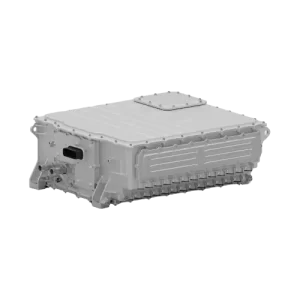
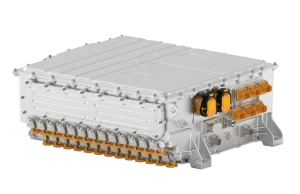
The GTAKE G03 motor controller provides published parameters that can be used as a technical reference when evaluating a fast-response, high-current controller architecture for autonomous agricultural machines.
The published model table lists a 400–750 VDC input range and peak-current options of 320 A, 410 A, and 525 A for one minute. It also lists support for synchronous and asynchronous motors, an output-frequency range of 0–1000 Hz, Resolver position sensing, and two motor-temperature sensing channels.
For response and control, the product information lists torque response below 5 ms and torque-control accuracy of ±5%. The published specification also lists configurable CAN communication, water cooling, IP67 protection, an ambient-temperature range of −40°C to 65°C, and rated-working-point efficiency of at least 98%.
Motor feedback is a practical decision. Resolver feedback and motor-temperature sensing can provide data for control and protection, but the selected motor, harness, controller configuration, and diagnostic strategy must be compatible. The project should also define which data must be exchanged with the central controller—torque command, speed, temperature, fault status, and diagnostics—including required messages, protocol, termination, and fault response.
GTAKE’s public G03 page does not identify agricultural machinery as an application. Treat these specifications as project-evaluation inputs, not evidence of agricultural deployment. They are not a substitute for application validation; final fit depends on the complete machine design, including the motor, battery, duty cycle, cooling capacity, wiring, safety architecture, installation method, and validation plan.
OEM integration and acceptance checklist
Use this as a control-performance acceptance list, not a generic controller shopping list.
- Define torque-command source and update rate from the autonomy/vehicle controller.
- Confirm CAN message set, timing, termination, and fault reaction.
- Confirm motor type, Resolver (or other) feedback, and temperature-sensor channels.
- Run a torque step-response test on the dyno or instrumented vehicle and record rise behavior.
- Check low-speed path-correction stability with implement load attached.
- Test headland-turn and slip-recovery cases against the traction strategy.
- Verify that peak-current duration covers the real transient events.
- Confirm cooling remains within limit during repeated correction events, not only during one peak.
- Review installation sealing, cable routing, and vibration in parallel—but do not treat packaging review as a substitute for control-loop validation.
FAQ: response and control only
What makes an electric motor controller “fast response”?
Response is the time required to adjust motor torque after a command changes. Its practical value depends on the complete control loop, including feedback, machine software, and mechanical response.
Does ±5% torque-control accuracy mean the vehicle will track path within 5%?
No. Datasheet torque accuracy is not vehicle path accuracy. Path quality also depends on localization, steering, implement load, and terrain.
Why must peak current still be reviewed in a response-focused project?
A fast loop that hits current or thermal limits will still lose authority during the events that matter most. Current level, permitted duration, cooling, and repeated-event frequency all matter.
Define the control-validation inputs
For a controller assessment focused on response and stability, provide the machine type, motor parameters, battery-voltage range, expected duty cycle, autonomy command interface, peak and continuous load, auxiliary-load profile, cooling conditions, and required communication functions.