

Compact agricultural automation platforms—small tractors, autonomous field vehicles, spraying platforms, crop-handling machines, and mobile farm robots—must start under load, move across uneven ground, and often run pumps or other auxiliaries at the same time. For these machines, the first electrical architecture decision is often not “which controller model,” but which battery-voltage platform to build around: a 340V-class system or a 540V-class system.
Voltage selection is an early architecture decision. The practical questions are when 340V makes sense, when 540V adds value, and what must be resolved before locking the battery, motor, cabling, and electric motor controller.
Define the machine before you define the voltage
Voltage selection affects more than the controller. At the same power level, a higher voltage can reduce current. That can help reduce conductor losses and may influence cable sizing. It also requires the battery, motor, connectors, insulation, protection devices, and service procedures to be designed for the selected voltage range.
Start with the duty cycle of the machine. Include normal operating load, short peak events, auxiliary loads, operating hours, ambient temperature, and the most demanding expected task. A platform that pulls an implement or starts on an incline may require a brief torque peak. A machine that runs a pump, fan, or other auxiliary equipment during movement may have a lower peak but a higher continuous electrical demand. These are different design cases, and they change how valuable a current reduction from higher voltage really is.
- What current is required during the highest-load event, and how long does that event last?
- What demand must be sustained during normal operation?
- Which auxiliary loads run at the same time as traction?
- What cooling conditions are available during the longest work period?
- Is the battery and motor family already fixed around one voltage range?
340V vs 540V: decision comparison
Neither platform is automatically better. The correct choice depends on the complete machine, not on voltage alone.
| Selection factor | 340V-class platform | 540V-class platform |
| Typical rated DC bus | Around 336 VDC (often called 340V platform) | Around 540 VDC |
| Current at the same power | Typically higher | Typically lower |
| Cable and connector demand | Requires careful current-capacity review | Requires careful high-voltage insulation review |
| Insulation and service | Lower insulation-voltage demand, still requires safe HV practice | Higher emphasis on insulation, interlocks, and service procedure |
| Best fit signal | Battery/motor already built around this range; moderate power; packaging favors existing parts | Architecture benefits from lower current at a given power; longer cable runs; higher continuous power |
| System decision | Stay if pack/motor/service are already 340V-class | Choose if lower current justifies HV redesign cost |
Three compact-platform cases
Case A: Small tractor or orchard platform with moderate continuous load
If the machine already uses a 340V-class battery pack and a matched motor, staying on 340V usually reduces redesign risk. The engineering focus then shifts to peak-current duration, cooling, and connector current capacity rather than forcing a voltage migration.
Case B: Spraying or crop-handling platform with long cable runs and simultaneous auxiliaries
When traction and pump/fan loads run together for long periods, conductor losses and connector heating become more visible. A 540V architecture may be evaluated because the same power can be delivered at lower current, provided insulation, contactors, and service methods are redesigned with it.
Case C: Compact autonomous vehicle with mixed peak and continuous demand
Loaded starts, soft-ground turns, and slope recovery create short high-torque events, while path following may hold a lower but sustained demand. Voltage alone does not solve peak-versus-continuous sizing; after the 340V/540V platform is chosen, still compare published peak-current duration with real events and confirm continuous demand under the available cooling.
Rough cable-current logic at the same power
A simple comparison helps explain why voltage is an architecture choice. For the same DC power, current roughly scales inversely with voltage. Moving from a 336 V bus toward a 540 V bus can meaningfully reduce conductor current for the same power target. That may ease cable cross-section and connector thermal stress, but it does not remove the need to review insulation class, connector creepage, protection devices, and workshop safety procedures.
Use this only as a first-pass engineering check. Final cable sizing still depends on peak duration, ambient temperature, bundling, connector ratings, and the full vehicle protection strategy.
When you should not raise voltage
- The battery, motor, and existing supplier ecosystem are already locked to 340V-class hardware.
- The power level is modest and cable heating is not the binding constraint.
- The service organization is not ready for a higher-voltage isolation and maintenance process.
- The project timeline cannot absorb a redesign of connectors, contactors, insulation monitoring, and validation.
- Packaging constraints make high-voltage clearance or connector choices impractical.
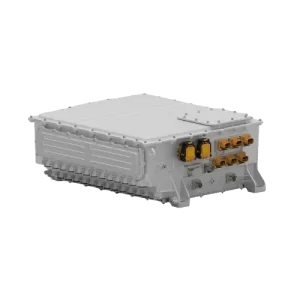
Technical reference: GTAKE G02 for 340V/540V compact platforms
Once the voltage platform direction is clear, the controller must still match motor type, current duration, cooling, sensing, and communication. The GTAKE G02 motor controller provides a published parameter set that can be reviewed when assessing a compact 340V or 540V controller architecture.
Its specifications list 336 VDC and 540 VDC rated-input options, with input ranges of 200–450 VDC and 400–750 VDC. Peak-current options are listed as 320 A or 410 A for one minute. The controller supports synchronous and asynchronous motors and provides Resolver position sensing, two motor-temperature sensing channels, and configurable CAN communication.
For environmental and installation review, the published information lists water cooling, IP67 protection, an ambient-temperature range of −40°C to 65°C, and rated-working-point efficiency of at least 98%. Its listed weight is 11 ± 0.5 kg, which may also be relevant where packaging and mounting loads are being evaluated.
GTAKE’s public G02 page does not identify agricultural machinery as an application. Treat these specifications as project-evaluation inputs, not evidence of agricultural deployment. Final fit still depends on the battery, motor, duty cycle, cooling loop, wiring, safety design, installation method, and validation plan.
Voltage-platform decision checklist
- Confirm whether battery nominal/maximum voltage is already fixed.
- Estimate continuous power and peak power from the real work cycle.
- Compare expected current at 340V-class vs 540V-class for the same power target.
- Review cable length, connector options, and thermal margin.
- Review insulation, interlocks, isolation monitoring, and service procedure readiness.
- Confirm motor voltage range, feedback method, and temperature sensing.
- Confirm cooling-loop capacity under the longest work period.
- Only then shortlist a controller family such as G02 against the chosen voltage range.
FAQ: voltage decisions only
Is 540V always better than 340V?
No. The suitable voltage depends on the battery, motor, power requirement, current level, insulation design, packaging, and service requirements.
Why do product pages say 336 VDC while projects talk about 340V?
In industry practice, “340V platform” often refers to a family around a rated bus near 336 VDC. Always design to the published rated and allowable input range, not the shorthand label alone.
Can one controller family cover both platforms?
Some families, such as G02, publish both 336 VDC and 540 VDC rated-input options. The specific model, motor match, and validation plan must still be confirmed for the project.
Start with the voltage-platform inputs
A useful technical review starts with the work cycle, motor data, battery voltage range, peak and continuous demand, auxiliary-load profile, cable and packaging constraints, and service requirements. With those inputs, the 340V vs 540V decision can be made before the controller is finalized.