

Electrifying agricultural machinery is not simply a matter of replacing a diesel engine with a battery and motor. Tractors, harvesters, and other off-highway machines often work at low speed under high load, while pumps, fans, compressors, and implements may operate at the same time. At higher power levels, the architecture question becomes sharper: should traction control, auxiliary drives, DC/DC, and power distribution remain discrete boxes, or should the project evaluate an integrated multi-in-one controller?
The better choice depends on the machine’s electrical architecture: an integrated high-power controller may reduce interfaces, while a discrete layout may preserve flexibility. The decision should be made from the duty cycle, auxiliary loads, packaging, and service plan—not from a preference for either format.
Start from the working duty cycle, then choose the architecture
The controller must handle both continuous work and short peak events. Tillage and towing may hold the traction system at high load for long periods; starting with an implement attached may require a brief current peak. Map traction demand, auxiliary demand, operating hours, ambient temperature, and the worst credible load event before comparing architectures.
- Continuous power and duration
- Peak torque, current, and event duration
- Auxiliary loads that may run at the same time
- Dust, moisture, vibration, temperature, and cleaning conditions
Architecture choice does not replace basic electrical matching. The selected layout—discrete or integrated—must still fit the motor type, voltage, current limits, speed range, sensors, and control method. Ask what cooling conditions apply to published ratings, when derating begins, and what temperature and diagnostic data are available, because those constraints affect whether one multi-in-one package or several discrete boxes is workable.
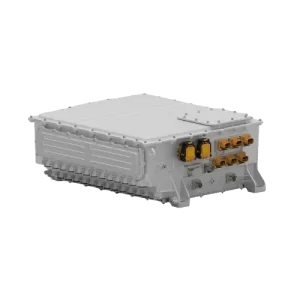
Discrete architecture: where the interfaces multiply
A discrete layout may use a separate traction MCU, oil-pump inverter, air-pump inverter, DC/DC converter, PDU, and insulation-monitoring devices. This can be flexible when auxiliary requirements are highly customized or when different suppliers own different subsystems.
The trade-off is interface growth: more HV/LV harnesses, more connectors, more packaging volume, more sealing points, and more diagnostic domains. Farm equipment already exposes electrical systems to vibration, water, dust, and cable wear. Every additional sealed joint and unsupported cable is another installation risk to manage.
Integrated architecture: what changes for the OEM
An integrated motor control unit can reduce interfaces and packaging work by combining traction control with selected auxiliary and distribution functions. That benefit appears only when the integrated boundary fits the machine’s electrical architecture and service plan.
| Topic | Discrete layout | Integrated multi-in-one layout |
| Harness and connectors | More HV/LV links between boxes | Fewer inter-box links; functions share one package |
| Packaging | Flexible placement, more volume | Higher density; placement must fit one larger unit |
| Validation domains | Each box validated separately, then integrated | One product boundary, but internal interactions must still be validated on the vehicle |
| Service / spares | Replace one failed subsystem | Service strategy must match the integrated module |
| Customization | Easier to swap one auxiliary supplier | Best when required auxiliaries match the integrated set |
| Protection | Isolation and PDU functions may be separate | Insulation monitoring and PDU can be designed into the same architecture |
When integration is a strong candidate
- The machine needs traction plus oil-pump and air-pump control in a commercial-vehicle-like electrical pattern.
- Packaging space and harness complexity are already project risks.
- The OEM wants fewer high-voltage interfaces and a clearer PDU / insulation-monitoring boundary.
- The auxiliary set is stable enough that a fixed integrated function list is acceptable.
- The OEM has defined diagnostic ownership, module-replacement procedures, and spare-parts support.
When to keep a discrete layout
- Auxiliary loads are unusual, numerous, or likely to change across machine variants.
- Different program teams or suppliers must own traction and auxiliaries separately.
- The service network is built around swapping smaller boxes, not a large integrated unit.
- Thermal or packaging constraints make one large liquid-cooled assembly difficult to place.
- The project only needs a traction controller and already has proven DC/DC and PDU hardware.
Technical reference: GTAKE M16
For OEMs evaluating a high-voltage automation architecture, the published characteristics of GTAKE’s M16 traction motor controller can be assessed against the vehicle’s duty cycle and integration needs.
The product page lists support for synchronous and asynchronous motors, a 400–750 VDC input range, 150 kVA rated output power, 270 kVA peak output power, liquid cooling, IP67 protection, and insulation monitoring. It also lists integrated MCU, oil-pump control, air-pump control, DC/DC, and PDU functions.
Product reference: EV/HEV traction motor controller – M16 frame. GTAKE’s public M16 page does not identify agricultural machinery as an application, so these characteristics are a starting point for architecture review—not evidence of agricultural deployment or a substitute for vehicle-level validation. Enclosure protection should still be reviewed together with connector sealing, strain relief, wire routing, mounting, overcurrent protection, and the machine’s service plan.
Architecture decision checklist
- List traction motor type, rated/peak torque, and speed range.
- List battery nominal and maximum voltage.
- List continuous and peak traction demand with durations.
- List every auxiliary that must run with traction (oil pump, air pump, others).
- Decide which auxiliaries must be supplier-flexible across variants.
- Compare harness count, sealing points, and packaging volume for discrete vs integrated.
- Define service: module replacement, diagnostics ownership, spare-parts strategy.
- Confirm cooling arrangement and installation space for the chosen architecture.
- Confirm environmental, safety, communication, and target-market requirements.
- Only then compare a candidate such as M16 against the architecture decision—not before.
FAQ: architecture choices only
What matters more for high-power work: rated power or peak power?
Both matter. The controller must sustain the normal duty cycle and deliver enough short-term capability for peak events. Architecture choice does not remove that requirement.
Why is liquid cooling important in an integrated high-power unit?
High-power, long-duration work creates heat. In an integrated package, multiple functions share thermal and packaging constraints, so the cooling system must be assessed with the controller rather than treated as an afterthought.
Is IP67 enough for every agricultural machine?
It may be suitable for some installations, but connectors, cabling, vibration, cleaning, and chemical exposure still need review—especially when one module concentrates many interfaces.
Prepare the architecture-review inputs
For a controller architecture review, prepare the machine type, motor data, battery voltage, continuous and peak demand, auxiliary loads, cooling arrangement, operating environment, target market, service model, and expected project schedule.