A copper wire drawing machine uses a series of dies to reduce the diameter of copper wire through controlled drawing force. During this process, the drawing section and winding or rewinding sections need to operate at coordinated speeds to maintain stable wire movement and production efficiency.
An AC motor drive provides adjustable motor speed and torque control for the drawing and winding sections. By coordinating the motor speed of each section, the wire drawing machine can maintain the required drawing speed while matching the winding and rewinding speed to the changing wire diameter.
A typical copper wire drawing machine consists of three main sections: winding, drawing and rewinding:
- Rewinding is generally passive rewinding.
- The drawing section operates at a controlled speed to draw the copper wire through the drawing dies.
- The rewinding speed is adjusted according to the required tension and drawing speed.
- The winding and rewinding sections require coordinated speed control to maintain stable wire tension.
The rewinding section is particularly important because its rotational speed changes as the coil diameter increases. The control system therefore needs to continuously match the winding speed with the linear drawing speed.
For this reason, AC drives for wire drawing machines need to provide stable speed regulation, coordinated motor control and appropriate PID or feedback functions according to the machine configuration.
AC Drive Solution for Copper Wire Drawing Machines
A complete wire drawing machine AC drive solution needs to coordinate the drawing motor with the winding and rewinding motors. The required drive configuration depends on the machine structure, motor rating, control method and whether an oscillating bar is used.
For standard applications, a general-purpose AC drive can provide the required variable-speed motor control. For applications requiring more precise speed, torque or feedback control, a high-performance AC drive can be selected.
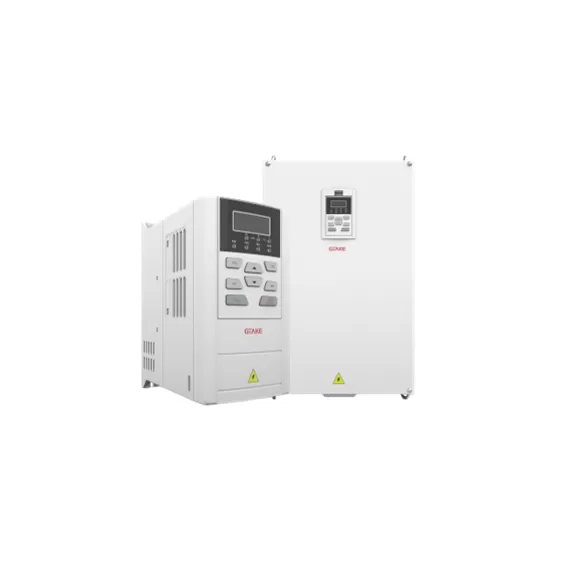
GTAKE provides GK620 General-purpose AC Drive and GK820 High-performance AC Drive platforms for different levels of motor-control requirements in industrial machinery. GK620 supports V/f and sensorless vector control, while GK820 supports V/f, sensorless vector and closed-loop vector control with encoder feedback.
AC Drive Control Requirements for Wire Drawing Machines
A wire drawing machine VFD or AC motor drive needs to be selected according to the actual motor and process requirements rather than only the machine name.
Key selection factors include:
- Motor rated power and current
- Input voltage
- Drawing speed
- Required speed range
- Starting and acceleration requirements
- Winding and rewinding tension
- Required overload capacity
- Speed feedback method
- PID control requirements
- Encoder or proximity-switch feedback
- Number of motors and AC drives
- Whether single or double winding is used
For applications requiring advanced speed and torque control, the GK820 High-performance AC Drive supports sensorless vector and closed-loop vector control, encoder feedback, PID and other control functions.
For more general motor-control requirements, the GK620 General-purpose AC Drive provides V/f and sensorless vector control and is positioned by GTAKE for a broad range of industrial machinery applications.
Why Use AC Drives for Copper Wire Drawing Machines?
The main purpose of using an AC drive for a wire drawing machine is to coordinate motor speed and torque with the requirements of the drawing process.
A properly configured wire drawing machine VFD can help:
- Control drawing motor speed
- Coordinate winding and rewinding speed
- Maintain the required wire tension
- Respond to changes in winding diameter
- Support PID-based speed regulation
- Integrate speed feedback from proximity switches or encoders
- Support different machine configurations
For machine builders and system integrators, the appropriate AC motor drive should be selected according to the motor rating, process speed, feedback configuration and required control performance.