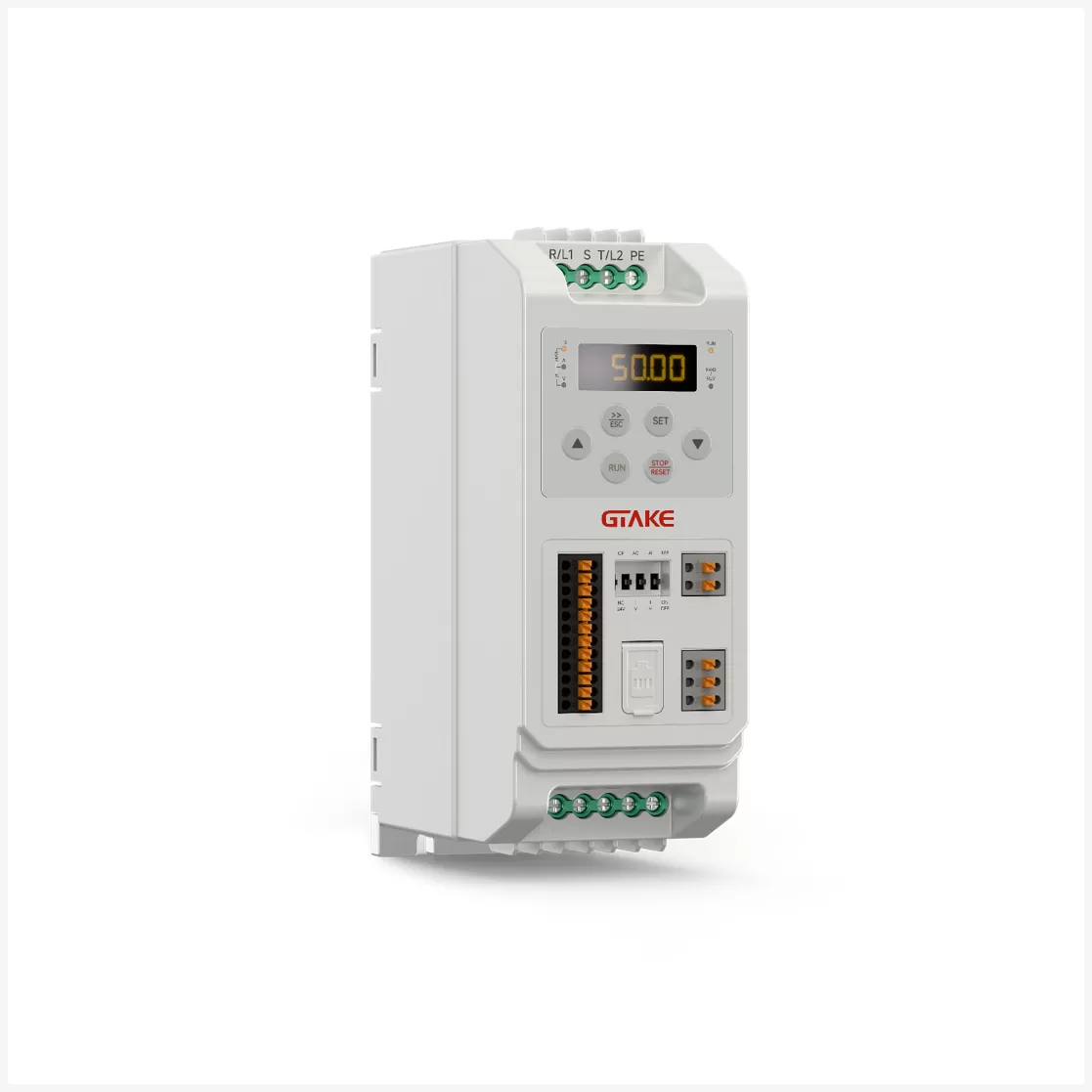
Speed control for AC motors is essential for optimizing performance, improving energy efficiency, and extending equipment life across countless industrial and automotive applications. Whether you need to regulate a conveyor belt, adjust a pump flow rate, or control the traction motor in an electric vehicle, GTAKE offers comprehensive solutions tailored to your specific AC motor control requirements. With decades of expertise in power electronics and motor drive technology, GTAKE delivers high-performance AC drives and motor controllers that set the standard for accuracy, reliability, and efficiency.
Understanding Speed Control for AC Motors
AC motor speed control involves adjusting the rotational speed of an alternating current motor by varying the frequency and/or voltage of the power supplied to the motor . The fundamental relationship between motor speed and supply frequency is defined by the equation:
Motor Speed (RPM) = 120 × Frequency (Hz) / Number of Poles
Since the number of poles in a motor is fixed, varying the incoming line frequency is the primary method for speed control, which is the basis for the operation of Variable Frequency Drives (VFDs) .
How AC Motor Speed Control Works
Modern speed control for AC motors typically involves several key methods:
Frequency Control: The most common method, achieved by using a Variable Frequency Drive (VFD) that converts incoming AC power to a variable frequency output, allowing the motor to operate at different speeds .
Voltage Control: Along with frequency control, voltage is adjusted proportionally to maintain the motor’s torque characteristics. When frequency decreases, voltage is typically reduced to keep the voltage/frequency ratio constant .
Pulse Width Modulation (PWM): In modern drives, PWM converts fixed AC supply into a controlled, variable-frequency AC supply by rapidly switching power on and off, adjusting the duty cycle to control effective power delivered to the motor. This method is highly efficient and minimizes energy losses .
Closed-loop Control: Advanced systems use feedback mechanisms to monitor actual motor speed and dynamically adjust input power, ensuring accurate speed regulation even under varying load conditions .
Types of AC Motor Speed Control Systems
GTAKE offers various control methods to match specific application requirements:
Variable Frequency Drive (VFD)
The VFD is the most common and widely used method for controlling AC motor speed. VFDs adjust both frequency and voltage, enabling precise speed control for applications such as fans, pumps, compressors, and conveyor systems . A VFD performs two primary functions: first, it converts incoming AC to DC through rectification; second, it inverts the DC back to a variable frequency AC signal .
Key VFD types include:
-
Voltage Source Inverter (VSI): Uses a diode bridge rectifier and capacitors to maintain consistent DC voltage
-
Current Source Inverter (CSI): Converts incoming AC to variable DC using thyristors
-
Pulse Width Modulation (PWM): Uses IGBTs to switch on and off, controlling both frequency and voltage
Sensorless Vector Control (SVC)
Sensorless vector control provides precise motor speed and torque control without physical sensors, making it ideal for applications requiring high dynamic performance such as conveyors, hoists, and industrial fans . GTAKE drives achieve speed control accuracy of ±0.2% with sensorless vector control.
Closed-Loop Vector Control
For the highest precision, closed-loop vector control uses encoder feedback to achieve speed control accuracy of ±0.02% and torque response of less than 5ms. This method delivers 200% starting torque at 0Hz, making it ideal for demanding applications like cranes, hoists, and elevators.
Field-Oriented Control (FOC)
FOC is an advanced method that decouples stator current into two orthogonal components, separately controlling magnetic flux (Id current) and torque (Iq current) . This enables independent control of torque and flux, delivering faster response and higher efficiency across the entire speed range.
AC Servo Drive
For applications requiring precise control of speed, torque, and position, AC servo drives provide high-precision control using feedback loops, making them ideal for robotics, CNC machines, and other high-performance applications .
GTAKE Solutions for Speed Control of AC Motors
GTAKE offers a comprehensive portfolio of products designed to deliver precise speed control for AC induction motors and permanent magnet synchronous motors (PMSM).
GK800 Series High Performance AC Drive
The GK800 series variable frequency drive delivers exceptional speed control performance for industrial applications with advanced control algorithms .
Key Speed Control Specifications:
-
Speed adjustable range: 1:200 (sensorless vector control), 1:1000 (closed-loop vector control)
-
Speed control accuracy: ±0.2% (sensorless vector control), ±0.02% (closed-loop vector control)
-
Torque response: Less than 10ms (sensorless vector control), less than 5ms (closed-loop vector control)
-
Starting torque: 180% at 0.25Hz (sensorless vector control), 200% at 0Hz (closed-loop vector control)
-
Output frequency range: 0.00-600.00Hz
-
Applicable motors: Asynchronous and synchronous motors
Control Techniques Supported:
GK820 Series High Performance AC Drive
The GK820 series is designed for demanding applications requiring precise speed and tension control, such as draw bench machines for metal processing .
Key Features:
-
Accepts various command sources: Modbus, Profibus-DP, CANopen, analog input, digital input
-
Built-in PID control for dynamic speed adjustment
-
Tension control capabilities with real-time feedback
-
Suitable for multi-motor synchronization applications
GK900 Series High Performance AC Drive
The GK900 book-type versatile AC drive offers advanced speed control capabilities for complex industrial applications.
Key Specifications:
-
Control techniques: V/F, sensorless vector control, closed-loop vector control
-
Speed adjustment range: 1:100 (V/F control); 1:200 (sensorless vector control); 1:1000 (closed-loop vector control)
-
Starting torque: 180% at 0.5Hz (sensorless vector control); 200% at 0Hz (closed-loop vector control)
-
Applicable motors: Asynchronous and synchronous motors
EV HEV Motor Controllers for AC Motor Speed Control
GTAKE’s electric vehicle motor controllers are specifically designed for the demanding requirements of traction applications, delivering precise speed control for AC motors across all operating conditions .
Key Features:
-
Wide speed range: Excellent torque output capacity across the entire speed range, including the constant power region above rated speed
-
Optimized control algorithms: Minimize motor loss and ensure high efficiency of the entire motion system
-
Motor compatibility: Supports both permanent magnet synchronous motors and AC asynchronous motors
-
Communication: CANopen (CiA 402), PROFIBUS, and other protocols for seamless system integration
-
Protection grade: IP67 for excellent environmental adaptability
Available Series for AC Motor Control:
-
D Series: D03, D06, D08, D09, D11 EV HEV motor controllers for light vehicles
-
G Series: G02, G03, G04, G05 EV HEV motor controllers for medium to heavy vehicles
-
M Series: M03, M04, M15, M16 frame EV HEV traction motor controllers for heavy-duty applications
KTZ38X41SGK Four-in-One Controller
This innovative controller combines motor drive with three auxiliary controllers (DC/AC + DC/DC + high voltage distribution), making it ideal for vehicles like HIACE and LINEAR models .
Key Specifications:
-
Compatible with synchronous and asynchronous motors
-
Input voltage: 200-450V
-
Output voltage: 0-380V
-
Current: Up to 410A
-
Features Infineon IGBTs with maximum junction temperature of 175°C
-
Excellent torque output capacity across the entire speed range
HB100-2Z45W Motor Controller
Designed for electric passenger cars, logistics trucks, and mini vehicles, this controller delivers reliable speed control for AC motors .
Key Specifications:
Technical Comparison: Speed Control Methods
Why Choose GTAKE for Speed Control of AC Motors?
1. Advanced Control Algorithms
GTAKE drives employ sophisticated control strategies including V/F control, sensorless vector control, closed-loop vector control, and field-oriented control to match the exact requirements of your application .
2. Wide Motor Compatibility
All GTAKE drives and controllers support both asynchronous (induction) and synchronous (PMSM) motors, providing flexibility in system design .
3. High Precision and Accuracy
With speed control accuracy as high as ±0.02% and torque response as fast as 5ms, GTAKE drives deliver the precision required for demanding applications.
4. Robust Performance
GTAKE products feature robust overload capabilities and wide operating temperature ranges, ensuring reliable operation in harsh environments .
5. Comprehensive Protection
Full protection features including overcurrent, overvoltage, overtemperature, and short circuit protection ensure reliable operation and equipment safety.
6. Global Certifications
GTAKE products carry CE, RoHS, and other international certifications, ensuring compliance with global standards.
Applications
Industrial Automation
-
Conveyors and material handling systems
-
Pumps, fans, and compressors
-
Machine tools and spindles
-
Printing and packaging machinery
-
Textile equipment
-
Draw bench machines for metal processing
Electric Vehicles
-
Electric passenger cars
-
Logistics trucks and delivery vans
-
Light commercial vehicles
-
Special vehicles and mini vehicles
Heavy-Duty Applications
Process Control
Frequently Asked Questions
Q: What is the difference between V/F control and vector control for AC motor speed regulation?
A: V/F control is a scalar method that maintains a constant voltage/frequency ratio, suitable for applications without fast dynamic requirements like fans and pumps. Vector control (field-oriented control) independently controls torque and flux, providing faster response, higher accuracy, and better efficiency across the entire speed range .
Q: Can GTAKE drives control both induction motors and synchronous motors?
A: Yes, GTAKE AC drives and EV controllers are designed to work with both asynchronous (induction) motors and synchronous (PMSM) motors .
Q: What speed control accuracy can I expect from GTAKE AC drives?
A: Depending on the control method, GTAKE drives offer speed control accuracy of ±0.5% with basic V/F control, ±0.2% with sensorless vector control, and ±0.02% with closed-loop vector control using encoder feedback.
Q: What communication protocols are supported for speed control integration?
A: GTAKE drives support Modbus RTU/ASCII as standard, with optional Profibus-DP, CANopen, and other protocols for industrial and vehicle applications .
Q: How does a Variable Frequency Drive (VFD) achieve speed control for AC motors?
A: A VFD first converts incoming AC power to DC through rectification, then inverts the DC back to a variable frequency AC signal using IGBTs or other switching devices. By varying the output frequency, the motor speed changes according to the formula RPM = 120 × Frequency / Number of Poles .
Q: Can GTAKE EV motor controllers support regenerative braking?
A: Yes, all GTAKE EV motor controllers support regenerative braking, capturing energy during deceleration to recharge the battery and extend vehicle range.
Q: How do I select the right speed control solution for my AC motor application?
A: Selection depends on your motor type (asynchronous or synchronous), required speed accuracy, dynamic response needs, power rating, and environmental conditions. Contact GTAKE engineers for personalized assistance in choosing the optimal solution for your specific application.
For detailed technical information or to discuss your specific speed control for AC motor requirements, please contact GTAKE. Our engineering team is ready to assist you in selecting the optimal solution for your application.